
Safe and reliable airport operations begin on the ground, where the optimal management of complex energy networks plays a central role. This includes electrical networks at all voltage levels, as well as pipeline networks for heating, cooling, process energy, gas, and water. Airport operators rely on ad-vanced software solutions to monitor and control these networks efficiently, stably, and securely.
PSI software solutions offer you...
for higher supply quality and improved KPIs
through automated network management
thanks to real-time distribution and load balancing
Challenges
Operators of modern airports are increasingly safeguarding against critical infrastructure failures by managing their own energy networks. This involves owning extensive power and pipeline networks and addressing considerable logistical and energy-related challenges.
Increased electricity demand
Airports have considerable electricity requirements that are expected to multiply several times by 2050. The expansion of renewable energy generation facilities, such as photovoltaics, along with the ongoing electrification of vehicle fleets, requires flexible and adaptive grid management.
Power failure as a risk factor
The increasing demand for electricity puts additional strain on the grids, and power outages pose considerable financial risks, as demonstrated by the millions in losses Heathrow Airport suffered during a 2025 outage.
Cybersecurity
The increasing threat of cyberattacks - with a recorded 70% increase among utility companies in 2024 - poses a further challenge to the security of energy infrastructure. Ensuring grid stability and supply security for critical systems, such as airfield lighting and navigation, is essential.
Integrated energy management for the "green airport" of the future
A major international airport, increasingly committed to decarbonization, faces the challenge of meeting its massive energy needs efficiently, safely, and sustainably. Electricity demand is expected to increase fivefold by 2050, while at the same time more and more re-newable energy generation systems, such as photovoltaics on hangar roofs and open spaces, as well as the ongoing electrification of the vehicle fleets (ground handling vehicles, airport buses, passenger EVs) are to be integrated. Airport infrastructure is also vulnerable to power outages, which can incur enormous costs. And, due to it is a critical infrastructure, it is a primarily target for cyberattacks.
The solution, based on a network management system such as PSIcontrol or PSIprins, enables comprehensive and integrated energy management!
Central network management and transparency
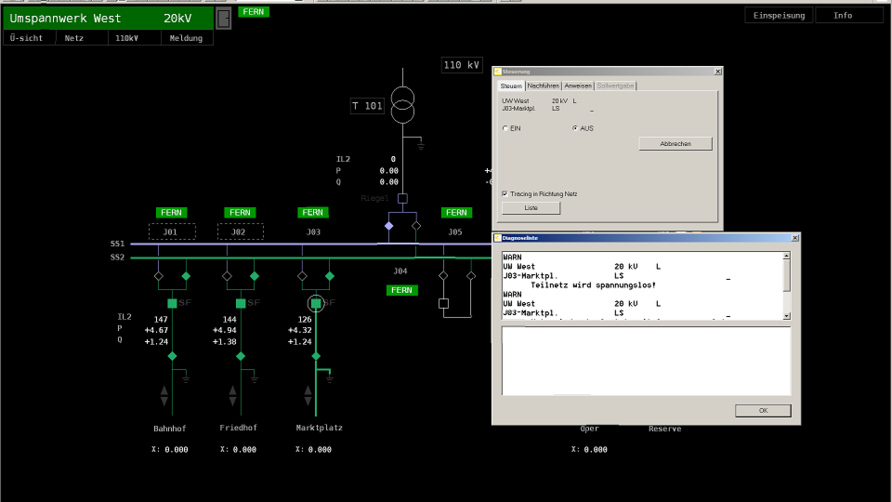
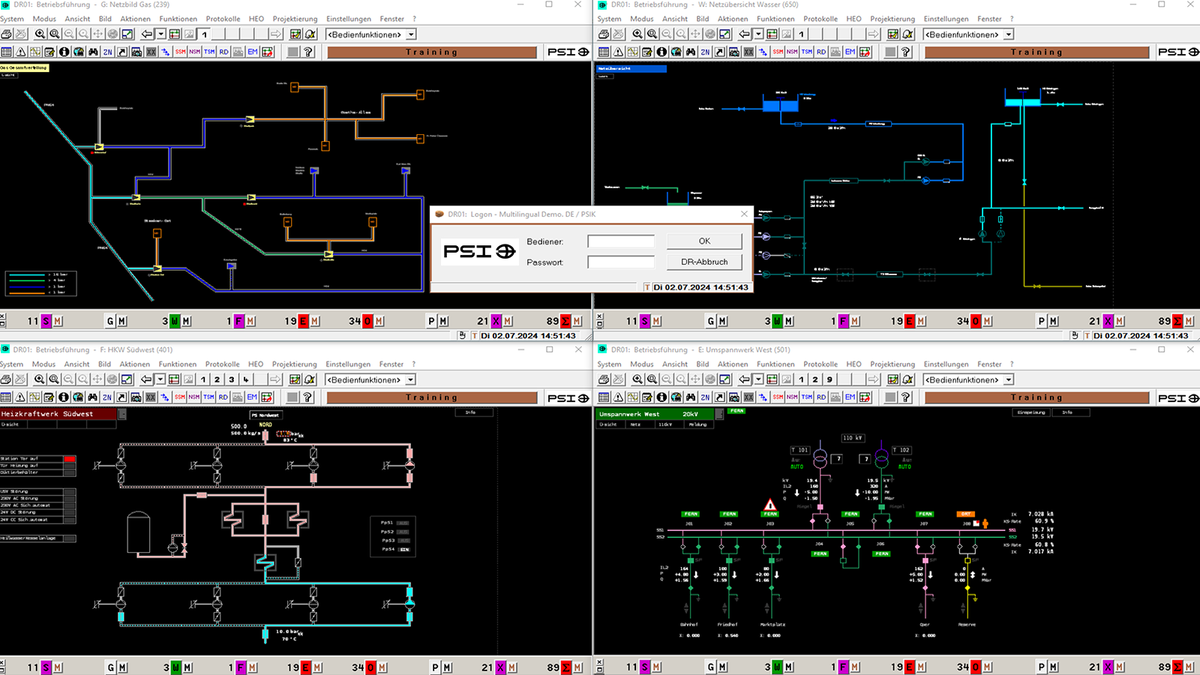
At the heart of the system is a central control room that monitors and manages the airport's entire energy network. It visualizes not only electrical networks across all voltage levels, but also all pipeline networks for heating, cooling, process energy, gas, and water. Real-time visualization of all operating and switching states, including airfield lighting and building automation, provides control room staff with a complete overview of the energy infrastructure.
Integration of renewable energies and battery storage
The photovoltaic systems installed on roofs and open spaces, as well as the associated battery energy storage systems (BESS), are seamlessly integrated into the grid control system. The system optimizes feed-in from these decentralized generators by considering the airport's current load to maximize self-consumption and minimize reliance on the grid.
Intelligent load and charging management
With the increasing electrification of the vehicle fleet, the charging of electric vehicles – from ground handling equipment and airport buses to passenger vehicles in parking garages – can be managed. To enable this, the control system is enhanced with modules for load and charging management for electromobility. Through automated load shedding, reconfiguration, and demand response measures, the load is dynamically controlled to avoid peak demand and significantly reduce electricity costs (often 13–40% of the monthly bill). Additionally, integrated HVAC and lighting systems can also be optimized.
Proactive maintenance and fault management
By integrating our control systems with the PSIcommand field force management system and the PSIgridmobile mobile component, machine learning and artificial intelligence enable early anomaly detection and proactive maintenance to prevent malfunctions. In the event of a fault, the system identifies the cause and initiates automated switching actions to quickly restore supply. Mobile service personnel receive all relevant information for troubleshooting and maintenance via mobile components, ensuring seamless processes from the control room to the field with complete documentation.
Secure connection to external networks
The airport's own energy Distribution Management System (DMS) is connected to the control rooms of the external distribution system operators (DSOs) and transmission system operators (TSOs) via the secure ICCP standard. This enables real-time data exchange, supporting coordinated load and outage management, enhanced grid stability, and increasing resilience against external grid disruptions.
This application scenario shows how an integrated energy management system enables an airport to optimally manage its complex energy networks, ensure operational reliability, reduce costs, and achieve sustainability goals at the same time.
Benefits
-
Increased reliability and safety
System reliability is increased through intelligent maintenance and rapid trouble-shooting, minimizing downtime for critical systems, and largely preventing cascad-ing failures and operator errors.
-
Siginificant cost savings
Optimized grid configuration and continuous power flow reduce technical losses and peak load costs, enabling a significant reduction in electricity consumption.
-
Sustainability and decarbonization
Supporting the integration of renewable energies and minimizing energy consump-tion contribute significantly to environmental goals.
Conclusion
Integrated software solutions and modern grid control systems are crucial for the efficient operation of the energy infrastructure of modern airports. They transform airports into smart energy partners that ensure safe and reliable operation through increased grid transparency, automated control, and efficient fault management. These systems play a key role in reducing costs, improving energy efficiency, and promoting decarbonization. By using state-of-the-art technologies such as machine learning, the energy infrastructure is optimally prepared to meet future challenges, including rising demand and increased security requirements.
Products used
PSIprins
The network control system for municipal utilities, distribution grid and infrastructure operators and industrial companies
-
Combined energies grid management
PSIprins enables you to act rather than to react: it manages power and gas as well as district heating (in fact, all pipe-bound energies) across all sectors in a combined system.
-
Cost optimized operation
PSIprins and its modules & services are highly standardized. The entire range of services is flexible, support multi-tenancy and is future-proof.
-
Scalability
PSIprins' high scalability provides the tools required by grid operators to optimize networks independent of their size: from single commodity to complex segment-spanning operations.