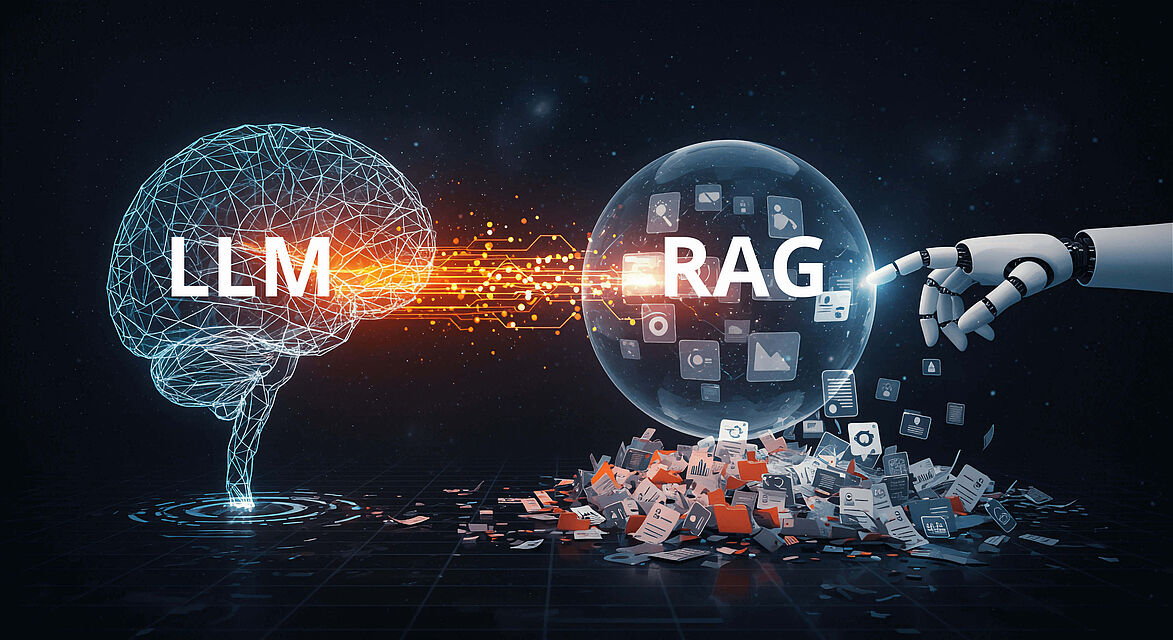
Large language models (LLMs) are powerful AI systems trained on massive datasets. They possess multiple parameters to perform tasks like answering questions, translating languages, and completing sentences. Their strength lies in their broad generalization across diverse topics and fluent language generation.
On the other hand, Retrieval Augmented Generation (RAG) is the process of optimizing the output of a large language model, so it references an authoritative knowledge base, such as an embedding model, outside of its training data sources before generating a response.
LLMs vs Retrieval Augmented Generation (RAG) solution
LLMs come with notable limitations for users, particularly in terms of their ability to index and retrieve information efficiently. First, they may hallucinate, generating plausible yet factually incorrect responses because their outputs rely solely on patterns learned during training. With the hallucination, it becomes difficult to attribute sources to information they generate which undermines trust and validation in the context of machine learning applications. Furthermore LLMs suffer from static knowledge because anything emerging after their training cutoff remains inaccessible, making them unreliable for real-time or specialized queries.
Additionally, LLMs are very expensive to train since they feed on massive datasets and to remain factual, they have to be retained from time to time to update their information. These constraints challenge their accuracy and usefulness, especially in high-stakes, domain-specific, or constantly evolving contexts.
To solve this problem, we can implement a langchain to enhance the retrieval of relevant data. Retrieval-Augmented Generation (RAG) system combine the strengths of information retrieval and generative AI to produce accurate, contextually relevant and dynamic responses and outputs. By integrating external or domain-specific knowledge into the generative process, RAG systems address the limitations of large language models (LLMs) that rely solely on their pre-trained general knowledge.
What is Qualicision A2 RAG system?
Qualicision A2 (Ask & Answer) is a RAG system that empowers software applications such as customer portals, support systems, or internal tools with a trustworthy, document-grounded conversational interface. Using the RAG paradigm, it ensures that generated text is anchored in authoritative materials like product documents, user manuals, concept papers, and knowledge bases.
General conditions of Retrieval-Augmented Generation
- Qualicision A2 is not a traditional Chatbot functionality.
- It extends the already powerful capabilities of LLMs to specific domains or an organization's internal knowledge base without the need to retrain the model, leveraging the latest embedding technology and using RAG for improved accuracy.
- Qualicision A2 is a cost-effective approach to improving LLM outcomes so that it remains relevant, accurate and useful in different contexts.
- It can be configured by users who are familiar with the business processes of the target applications, but are no data scientists at all.
- Qualicision A2 is highly efficient in processing and indexing information for rapid retrieval.lexible when considering the backend LLM. Currently, it is running on Ollama (an open-source model) and later, it will be Google Gemini, utilizing advanced embeddings for enhanced performance. Depending on customer requirements, the underlying LLM can be exchanged, which makes the system highly adaptable.
- Finally, QA2 has a clear advantage over traditional LLMs when it comes to training speed, thanks to its optimized machine learning algorithms. Each time a user uploads a document, only that document needs to be processed rather than retraining the entire model. This makes enriching the system with new knowledge significantly easier, faster and cheaper.
Context features for RAG model
In Qualicision A2, users can upload documents into different groups called contexts, which can then be chunked for better processing. When starting a conversation, they can then select which context(s) (one or more) should be included. This allows the system to separate documents and bring only the relevant knowledge into scope.
Usage Scenarios for best embedding RAG model
Most PSI software solutions are already equipped with optimizations and decision components based on Qualicision AI, including PSIpenta, PSIcommand.
| Scenario | Description |
|---|---|
| Product support chatbot | Enables customer-facing apps to answer technical questions about product functionality by retrieving exact passages from user manuals. Each reply includes links or references to the original documents. |
| Interactive technical documentation | Engineers and support staff ask about maintenance procedures or error codes; A2 responds with accurate information and points to the relevant sections in maintenance manuals or concept papers, leveraging a vector search algorithm. |
| Adaptive conversational guides | Users can adjust topic priorities via GUI sliders—e.g., shifting conversation emphasis between “safety”, “usability”, or “performance”—to tailor the style or content depth of responses. |
| On-the-fly retraining | Through embedded confirmation/discard prompts, the system learns from interactions to better prioritize sources or re-phrase responses over time. |
How does RAG improve the accuracy of AI responses?
- With RAG-based PSI Qualicision A2 ensures responses are based on current, verified documentation, minimizing hallucinations and inaccurate statements.
- Every answer includes citations or links to the most relevant source documents—enhancing transparency and allowing users to validate content.
- Topic-priority sliders let users influence response tone and focus dynamically, enabling context-sensitive and domain-aware interactions.
- PSI Qualicision A2 operates on cloud or on premise and gives the customer full control over data, training, and compliance. Training can be completed in just hours, enabling rapid deployment of new algorithms.
- Can be embedded in PSI products, legacy applications, or third-party systems with no prior PSI exposure required, thus opening up a broad, untapped market.
- Upload of documents in various formats (word, pdf, html, txt) to facilitate vector search capabilities.
- Can run as SaaS / PaaS / Docker Stack.
- For both internal and external use.
Illustrative example of Qualicision A2 RAG
Suppose a steel producing customer at the shopfloor asks:
PSIQualicision A2 would:
- Retrieve the relevant section from the product manual (e.g. Chapter 4, Section 2).
- Generate a concise, clear summary answer based on that content using similarity search techniques.
- Provide a citation like “See manual: Chapter 4, Section 2 — ‘heat treatment duration for different steel grades’.”
- Offer a link or reference so the user can explore the full documentation if desired.
If the application’s “safety” slider is set high, the system emphasizes safety warnings and calibration tolerances. Over time, if the user consistently corrects or accepts responses, A2 learns to select the most helpful phrasing or sources.
Conclusion
PSIQualicision A2 transforms static technical and product documentation into a dynamic, reliable conversational interface. By combining RAG-based grounding, customizable response behavior, and secure deployment, it empowers organizations with a powerful tool to:
- Mitigate hallucinations and increase accuracy.
- Offer transparent, source-linked explanations.
- Adapt conversations based on topic relevance and user needs.
- Safeguard data within customer-controlled infrastructure.
- Deploy across diverse applications thereby opening up a broad usage spectrum.