
Case Study Automotive and industrial supplier relies on PSIglobal
Analysis and restructuring of the distribution network of over 200 warehouses.
The global automotive and industrial supplier operates at several hundred sites worldwide and thus has a global network of production sites, research and development facilities, and sales companies.
- Industry: Suppliers to the automotive and mechanical engineering industries
- Customer since: 2012
- Deployed software: PSIglobal
- Realized interfaces: Different ERP systems of the individual countries in the EU
- Type of optimizations: Greenfield, Brownfield
Mastering challenges
The group decided to completely examine and restructure its distribution network to be able to supply customers in Europe quickly and efficiently with the complete product range in the future, while increasing customer satisfaction and optimizing distribution costs. Orders per customer, which at that date had sometimes been served from several warehouse locations, were to be dispatched centrally from just one warehouse location after optimization.
Customer's objective
The main objectives of the automotive and industrial supplier were to strategically optimize its global, highly complex logistics network and future-proof it through the use of PSIglobal. The company sought to achieve maximum transparency across all international goods flows and locations in order to identify existing inefficiencies.
A key objective was to reduce transportation costs and lead times while ensuring unrestricted delivery capacity for automotive and industrial series production.
In addition, the goal was to establish a data-driven foundation to flexibly simulate site decisions (greenfield/brownfield), optimize warehouse capacity utilization, and sustainably increase flexibility in response to market fluctuations.
Solution approach
PSIglobal can process large amounts of data in multi-stage and complex logistics networks easily and quickly. A feature that benefit the planned project, as the upcoming analyses and calculations concerned the entire two-stage goods distribution in Europe, including a very high number of articles, shipments and orders (150 million data sets).
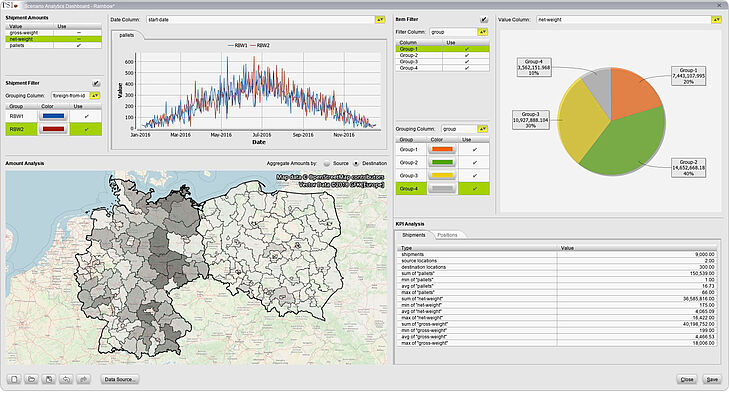
Furthermore, PSIglobal made it easy to import data from various ERP systems in the individual EU countries. This step enabled the company to visualize the entire supply chain across all stages of the value chain and modes of transportation. On the way to realigning the central warehouse structure in Europe, the ACTUAL network was first analyzed extensively in tabular and graphical form to design preferred supply chain variants. Greenfield scenarios were used to calculate an optimal number and location of new sites for consolidation purposes. In doing so, the Group always kept an eye on the markets with the existing customer structure. In addition, the project team considered the different customer requirements, e.g., in terms of speed of delivery. Based on this, the evaluation of the possible new warehouse locations was carried out in brownfield and real scenarios.
Solution components
- Data import
- Analysis/visualization
- Distance calculation
- Extrapolation/prognosis
- Location optimization
- Table and graphic export
The result in detail
After performing all calculations, three logistic nodes in Europe had been identified where warehouses of different sizes were established or operated. The restructuring has resulted in efficiency gains at many levels within the group. Added to this were new and more efficient backbone routes, as well as a significant reduction in transport costs due to higher utilization of truck capacity. In addition, inventories were reduced throughout the network and the productivity of individual warehouses was increased.
Conclusion
The case study demonstrates how essential data-driven network planning is for global suppliers. The use of PSIglobal enables the company to continuously analyze complex goods flows, fully leverage cost-saving opportunities, and establish a highly flexible, resource-efficient logistics system that consistently meets the stringent requirements of the automotive industry.