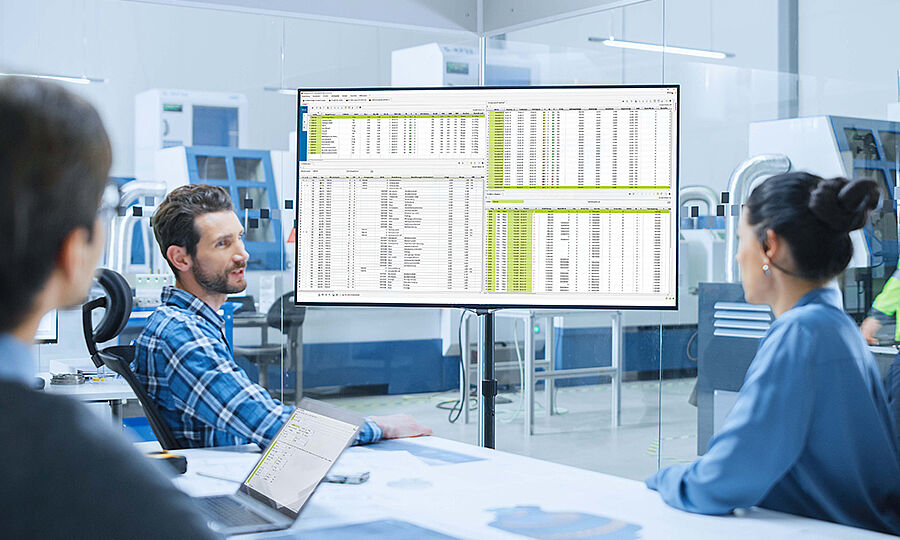
Record returns in a structured manner
Many manufacturing companies regularly receive returns from customers—sometimes in the form of several parts loosely packed in boxes. These must be systematically accepted, checked, and processed both technically and commercially. “Many PSIpenta users employ the integrated service management system for repair acceptance and processing. For most, this works well,” explains Christian Simonovic, Product Owner at the Discrete Manufacturing Business Unit. “However, those who have to process a particularly large number of small-part returns need additional options for systematically grouping returns and then processing them in batches in the ERP system.”
A new standard: the complaint management module in PSIpenta/ERP
Against this backdrop, a new module has been developed in version 10, which is now an integral part of PSIpenta/ERP as complaint management. “This extension was developed on the initiative of and in close cooperation with a long-standing customer – and is therefore literally based on practical experience for practical use,” says Christian Simonovic. The new functions map the entire process from delivery to diagnosis and repair to invoicing in a system-supported and consistent manner – and are based on the real requirements of the industry. In addition to complete integration into the ERP system standard, companies benefit from clearly defined workflows, automated process steps, and a complaint history that can be traced at any time.
Complaint handling at a glance
- Delivery and acceptance
Returns are accepted and assigned to a central complaint object. - Structuring and diagnosis
The parts can be grouped together into processing groups. This is followed by technical and commercial evaluation, including repair calculations. - Approval and implementation
Approved items are automatically transferred to orders. Repair, delivery, and invoicing are carried out directly in the ERP system.
Less effort, more structure: What the module achieves in practice
For many companies, complaint and repair management are key components of efficiency, transparency, and customer satisfaction. The new module in PSIpenta/ERP makes return processes traceable, reduces manual effort, and creates clarity from goods receipt to invoicing. “Depending on the volume, companies can save a significant amount of time per complaint and significantly reduce their monthly expenses,” says Simonovic.
- More efficient processes
Instead of recording returns individually, they can be grouped and processed together—this saves time and reduces sources of error. - Better traceability
From the first customer contact to invoicing, every step is documented and systematically linked. - Seamless ERP integration
The entire process is handled within PSIpenta/ERP—without interruptions, exports, or additional tools.
Return processes under control
What began as a specific request from the user community is now standard: the complaint management module in PSIpenta/ERP provides companies with a tool that enables them to process returns in a structured, transparent, and cost-effective manner. This is a benefit for day-to-day business and an important step toward fully digitized business processes.
Are you ready for the next step?
Get in touch with us — we will be happy to advise you on how to get started in the world of PSIpenta!