
This article shows why the view of operating models is changing, what reservations companies have, and how the transition to cloud-based models can be realistically prepared.
Proven ERP and MES landscapes under new conditions
ERP and MES have been the stable backbone of value creation in discrete manufacturing for years. Many companies work with industry solutions such as PSIpenta, which map typical processes in the standard and have proven themselves in everyday use. In addition, configurable workflows and extensions within the standard enable companies to respond to specific requirements without unnecessarily complicating the system landscape.
This combination of stability and adaptability has proven itself over many years. At the same time, the framework conditions under which ERP and MES are operated are changing. Production sites are growing internationally, projects are becoming more dynamic, and IT teams are under greater pressure. In addition, requirements for availability, security, and maintainability are continuously increasing. Against this backdrop, the focus is shifting from the functionality of the systems to the question of how proven ERP and MES landscapes can be operated efficiently and reliably in the long term.
The cloud as part of IT reality
A look at practical applications shows that the cloud is no longer in conflict with existing IT, but rather complements it in many areas. Numerous companies use cloud-based applications for CRM, document management, reporting, and HR, among other things. These solutions fulfill clearly defined tasks, can be easily integrated into existing IT landscapes, and have established themselves in daily operations.
ERP and MES play a special role within this landscape. They control central workflows, intervene deeply in processes, and must function reliably even under high loads. The requirements for security, stability, and traceability are correspondingly high. Here, the cloud is not seen as a replacement for existing solutions, but as a complementary operating model that only makes sense if it is based on clearly structured processes and a sustainable system architecture.
It is precisely where industry solutions already map typical processes in the standard version and enable adjustments via configurable mechanisms that the necessary basis for this further development is created. Cloud capability thus becomes less a question of technology and more a consequence of a consistently standard-based system approach.
Why requirements for ERP and MES operating models are changing
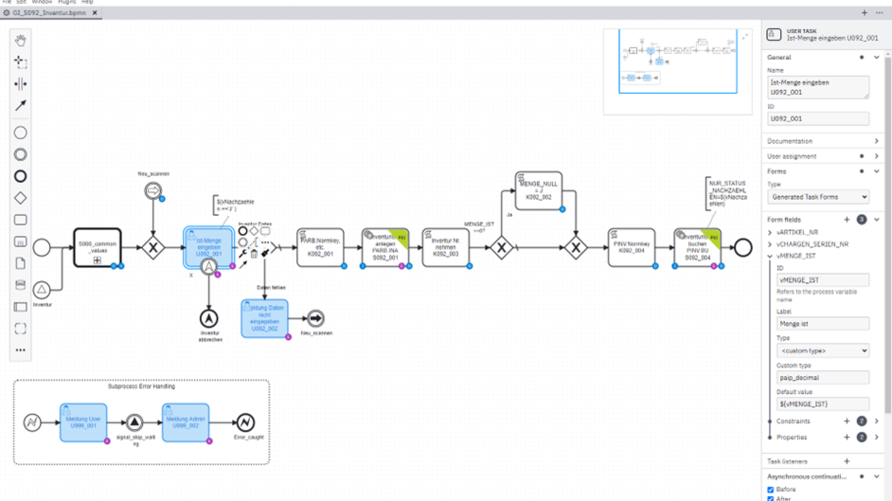
What is changing in many companies is not so much the functional role of ERP and MES as the expectations placed on their operation. Systems should not only run reliably, but also be able to adapt flexibly to new conditions. International cooperation, fluctuating capacity utilization, and changing supply chains have a more direct impact on processes and IT structures today than they did a few years ago.
At the same time, the effort required to keep complex landscapes stable in the long term is growing. Updates, security requirements, and increasing availability demands can only be implemented in a manageable way if systems are clearly structured. Where processes are mapped in the standard and extensions are made via defined workflows, operations remain predictable – even when the environment changes. Against this backdrop, the question of suitable operating models is becoming increasingly important.
SaaS and on-premises in a factual comparison
ERP as SaaS primarily changes the way responsibility is distributed. Operation, maintenance, and updating are the responsibility of the provider. This gives internal IT teams more freedom, for example, for process proximity or further development. At the same time, this model requires trust in stable interfaces, clear release logic, and a reliable infrastructure.
On-premises solutions continue to offer a high degree of control and enable in-depth customization. They are well suited to production environments with clear processes and long-term stable requirements. In practice, many companies combine both approaches. Hosting models, hybrid architectures, or modular entry points create scope for maneuver without calling existing structures into question. At the same time, it is clear that this combination is often seen as a transition – driven by the expectation that operating models will be developed further step by step.
For MES, the question of SaaS or on-premises is more nuanced in some areas. MES systems are closely linked to manufacturing, collect production-related data, and support processes directly during operation. The requirements for availability and stability are correspondingly high. These special features should not be seen as arguments against the cloud, but rather shape the requirements for the respective operating model. In modern MES SaaS approaches, particularly time-critical functions remain close to production, while higher-level tasks such as evaluation, planning, or cross-location transparency are mapped in the cloud. Consequently, the decisive factor is not so much the basic form of operation as the clarity with which responsibilities and functions are separated from each other in the system.
Would you like to gain a deeper insight into PSIpenta/ERP 10?
In our recorded webinar, you can learn more about the features and individual migration options for your company - explained directly by our product experts.
Risks, reservations, and their classification
Security issues, data protection, and adaptability characterize the reluctance toward cloud solutions. In practice, however, the picture is more nuanced. Hardly any aspect is considered exclusively a risk. Many assessments range between caution and openness.
An internal survey of PSI user companies in discrete manufacturing shows a similar picture. It does not claim to be representative, but it does reveal how nuanced cloud models are currently perceived. Issues such as security, data protection, and individual adaptability can rarely be clearly classified. Instead, a balanced attitude prevails, taking both opportunities and reservations into account.
It is striking that concerns often arise where roles, responsibilities, or technical concepts remain unclear. Cloud technology itself takes a back seat. What is more important is how well new operating models fit into existing processes. Where companies take a structured approach and rely on clearly defined standards, many reservations lose their significance.
Gradual approach instead of abrupt change
For many manufacturing companies, the journey does not begin with a complete switchover. Preparatory steps are often the priority. Hosting variants, cloud-based architectures, or individual SaaS modules allow companies to gain experience without disrupting production processes.
- Standardized processes simplify operations because updates, maintenance, and scaling remain predictable.
- Configurable workflows replace individual special solutions without restricting flexibility.
- Clear system architectures create transparency in terms of responsibilities, interfaces, and release cycles.
- Low dependence on individual code simplifies further development and migration.
- Standardization makes it possible to develop operating models step by step instead of making selective individual decisions.
On this basis, the next step can be prepared without calling existing structures into question. ERP and MES evolve together with the organization, IT, and business model. The cloud thus becomes not an end in itself, but an option that arises from proven standards.
Development with perspective
The question of ERP and MES SaaS or on-premises can be understood today less as a description of the current situation and more as a question of development. The requirements for ERP and MES are changing, as are the expectations for their operation. Cloud and SaaS models are gaining in importance because they open up new scope for scaling, maintenance, and further development.
At the same time, the starting point remains clearly defined. Standardized industry solutions create the basis for the gradual further development of existing ERP and MES landscapes. The transition to cloud-based models follows a structured migration path. It incorporates existing systems rather than replacing them and opens up perspectives for the next phase of development.