In steel production, traditional ANSI/ISA-95 automation pyramid has limitations in the Industry 4.0 era. PSI Metals' PSIbus, a service-oriented ecosystem, breaks down this traditional pyramid thereby facilitating cross-layer communication, improving reactivity to unexpected events, and enhancing data accessibility.
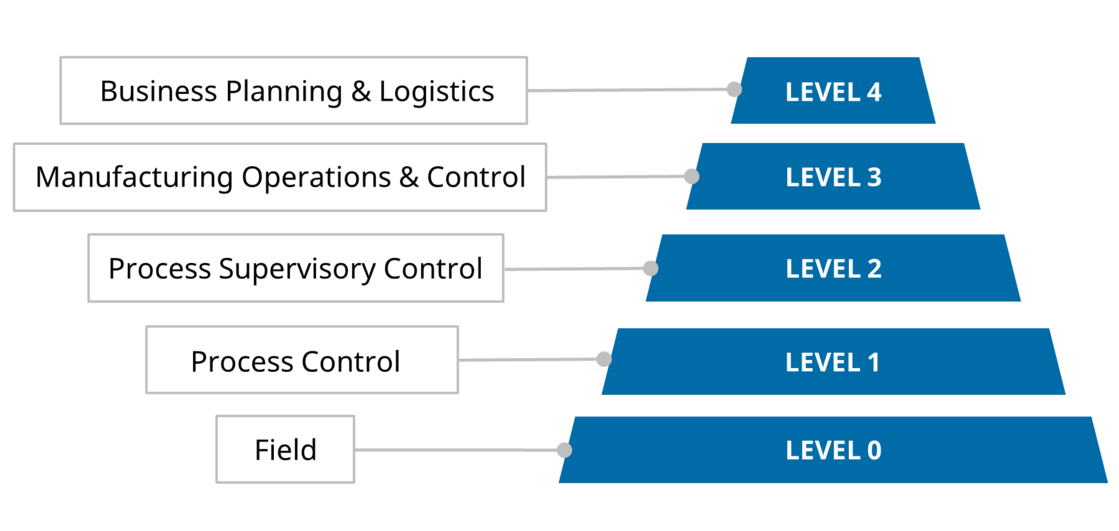
International automation standards such as ANSI/ISA-95 organize steel production in a layered hierarchical way: from process control (Level 1), to process automation (Level 2), to manufacturing execution (Level 3), and up to business management (Level 4). This automation pyramid has been broadly accepted and implemented by most steel producers worldwide. As long as business processes remain in one layer, the corresponding IT applications work adequately and efficiently.
The rising demand for cross-layer business processes and functionalities (e.g. Big Data Analytics, Machine Learning, IoT and Sensors Everywhere) heavily questions this layered approach. Often these cross-layer business processes meet artificial layer borders as obstacles. These obstacles are creating problems such as lack of required data due to layering abstraction, inflexibility towards quickly adapting to changes between layers and performance issues caused by unrequired transformations across several layers.
Booking a flight and reserving a seat is a perfect example of this cross layered functional world. During the booking process, many services are utilized, but we expect them to be part of a seamless business process where all involved layers remain invisible. The same cross-layered expectations are required for the next generation of production management solutions for the steel industry.
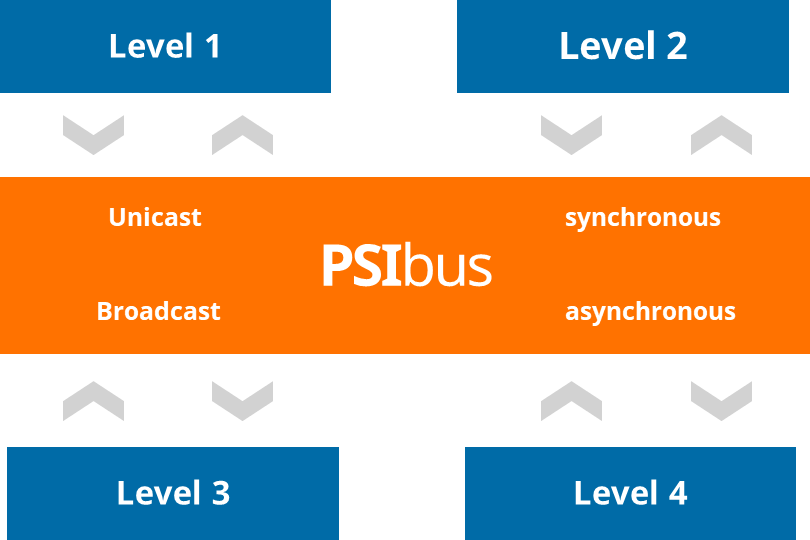
This service-oriented ecosystem relies on a common protocol and a unified way of communicating to centralize all service communications. A while ago, PSI Metals introduced the PSIbus and its extensions to form a Metals Enterprise Service Bus. It is a ready-to-use software infrastructure enabling to connect services together as part of a workflow.
Increased Reactivity to Unexpected Steel Production Events
These cross-layer workflows enable users to trigger directly a service from another layer when required. For example, the Level 2 information about an actual production deviation at the caster could directly trigger a reactive cutting plan optimization in order to adjust how to cut a slab with given characteristics, considering the order book. Thanks to this reactive service, the slabs will be cut at the right length and will remain allocated to existing orders at the exit of the caster, even if the production deviates from the plan.
Another example is to combine in the same workflow the trimming knives status monitoring with a reactive scheduling service in order to only process materials which do not require any trimming in case the knives are not sharpened enough.
Those examples show that users can increase their reactivity in case of unexpected events thanks to the service-oriented workflows across layers. This tremendously improves the production throughput and indirectly reduces the energy consumption.
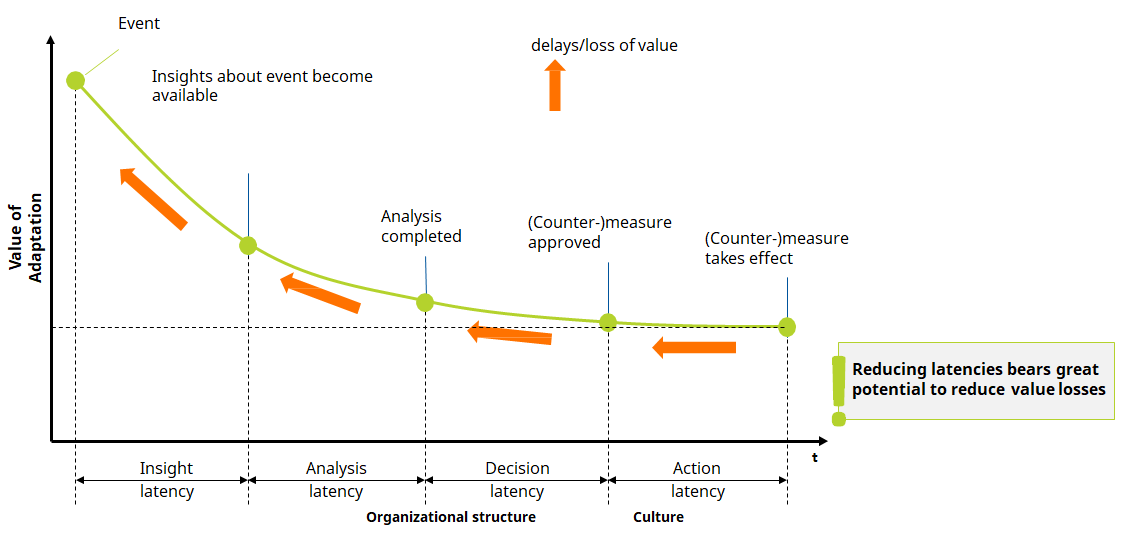
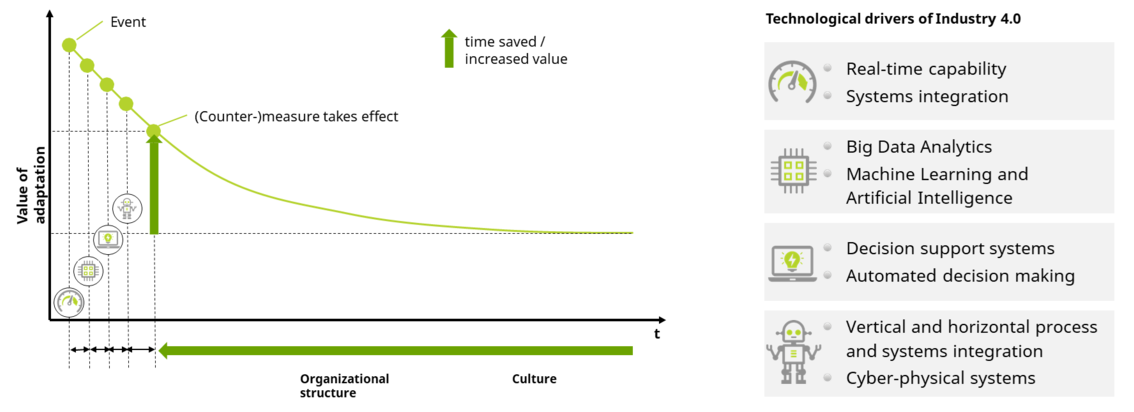
This collaborative and service-oriented ecosystem also enables users to shorten the time needed to react to unexpected events. As shown in Figure 3 and Figure 4, all the phases of the reaction to an event can be improved by digitalization:
- Better Insight through systems integration
- Better Analysis using Big Data Analytics and Machine Learning
- Better Decisions, on the one hand by supporting operators with Decision Support Systems and on the other hand by automating decision making
- Better Actions that can be triggered across system, and even organizational boundaries
Accessible Data Wherever It Is Valuable During Steel Production
These cross-layer workflows also enable users to combine the information from a layer with the functionality of another layer. Indeed, in this architecture, the data sent from a component A in a layer to a component B in another layer is fully enriched and not biased by possible mapping, abstraction, and transformation of another component C, that would have been passed in Level 3 in an automation pyramid organization.
For example, the reactive cutting plan optimization mentioned above is only possible if the actual production data is sent from the Level 2 to the reactive service. Another example, a machine learning model to predict material defects per production route could be used to better select the optimal production route during planning. But such a Level 3 algorithm would need to have access to some raw data from Level 2 (e.g. temperature measurements and material measurements).
Managing Steel Production Workflow and Orchestration
All these services need to be organized as part of workflows. The business user 4.0 will use PSImetals Workflow Management to tailor service interaction to their specific needs and to easily adjust their solution to the changes in the production. It orchestrates all service interactions via PSIbus events and enables them to monitor the workflow status and control it (e.g. start and stop). It also enables the user to easily integrate 3rd party services. Furthermore, the workflow configuration does not require any coding in order to enable business experts to configure the workflows to their needs.

Steel Production Planning 4.0 for the User 4.0
As described earlier, a major improvement to the planning process will be to allow users to configure business processes through services from different areas and levels. Those configured workflows will be adjusted depending on the circumstances.
Changes in a planning layer will be automatically considered in the other layers based on a configured service workflow.
Workflows will also support some needs around “Autonomous and Adaptive Scheduling”. Indeed, some monitoring services will be able to trigger some configuration changes or some schedule adaptations. The next webinar AI-Driven Scheduling & Smart Agents will detail out these possibilities.
Users 4.0 will spend more time on strategic tasks and will no longer do repetitive tasks. Workflows will also incorporate some machine learning models to recommend decisions based on the past decisions of the experts. This will help all users to make quick decisions at any time of the day or night, especially in absence of the specific expert.
Users 4.0 will also analyze the deviations to understand why the plan was not executed as planned in order to adjust some constraints so that the plan will be executed properly in the future. Therefore, data analytics will be an important skill.