![[Translate to English:]](/fileadmin/_processed_/f/1/csm_PSI_People__76__06c871eca3.png "[Translate to English:]")
“Why is this order late?” is a question that triggers days of manual data hunting, fragmented system checks, and educated guesswork. Production delays are rarely caused by a single factor. Instead, they are due to complex interaction of orders, machines, materials, schedules, and human decisions across multiple system layers. Traditional approaches struggle precisely because this complexity is siloed. Every late order tells a story; most companies just don’t hear it on time.
Answering this critical question requires a seamless combination of data integration, process understanding, and Artificial Intelligence (AI)-driven analytics. PSI’s holistic Production Management approach and its Industrial AI capabilities close this reality gap and reduce the time from 24 hours to just 10 minutes. Our mission is to provide precisely this capability, moving beyond fragmented data logging to full diagnostic intelligence. We utilize AI-driven analytics to "glue" different data contents together and formulate a natural language answer.
The reality gap: From 24 hours to 10 minutes
To understand the value of this approach, we must look at the current situation that many manufacturers face. Today, a phone call to the quality department asking, "Why is this order late?" triggers a massive manual effort. The Quality Engineer typically has to log into several different systems: for example, the steel plant to check the produced heat, the caster for slab production, and the hot mill for coil production.
First, they need to access the standard view for each of these systems and export PDFs. Then, because not all needed subsystems and sensors are in the standard data view, they require detailed views and very specific database queries to retrieve the genealogy. This manual process of data collection and cleaning takes a full day.
PSI changes this dynamic entirely. Instead of a single day of manual data collection, the process is reduced to approximately 10 minutes. It takes just one minute to request information in natural language via a GenAI-powered embedded Chatbot within the PSImetals application. The Chatbot enables users to easily retrieve context-related information in their daily work by generating a detailed answer for a specific question, complete with reliably sourced information.
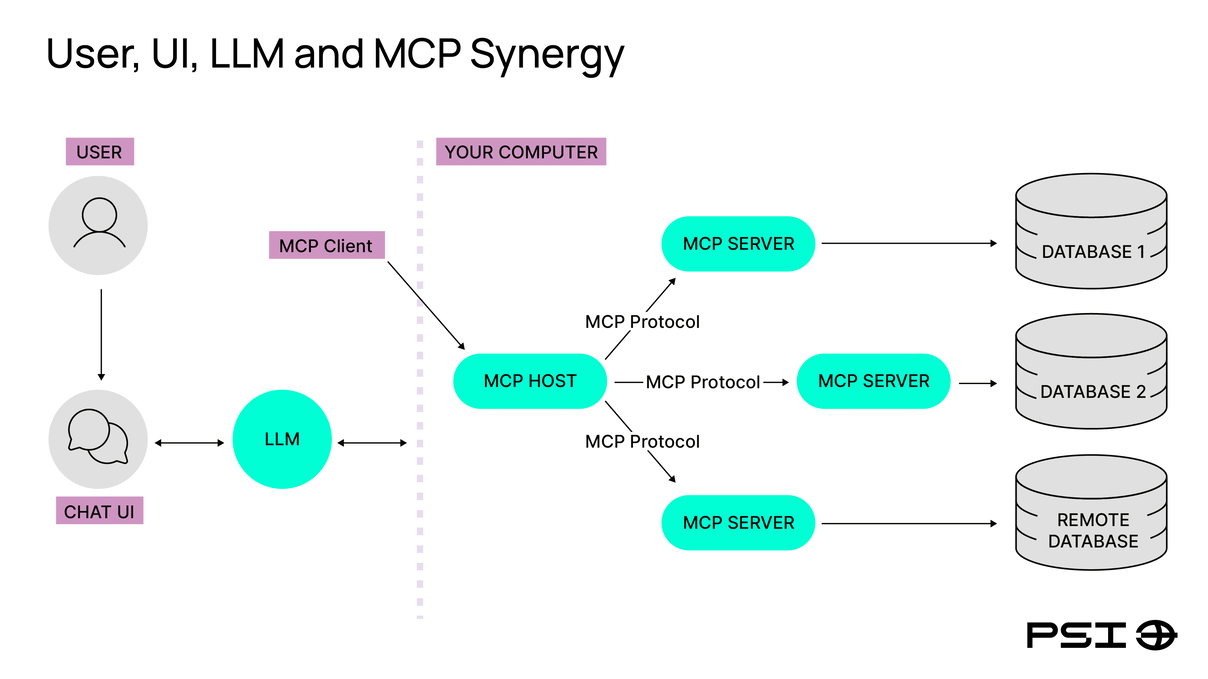
Behind the scenes, this capability is powered by PSIqualicision A2 (Ask and Answer) technology, which uses a language model and Retrieval-Augmented Generation (RAG) to process and generate texts which is connected via PSImetals MCP to the PSImetals’ central Factory Model as the reliable source of truth. The full iterative process, guided by the quality engineer, requires roughly 10 minutes to retrieve and refine all relevant information.
Detective analogy: Understanding delivery delays and late orders as a crime case
To understand the architecture behind this analysis, it helps to step away from the technical details for a moment. Imagine a specialized team of detectives investigating a case.
The Archivist: Has access to all the order books and schedules.
The Field Agent: Watches the production floor in real time.
The Forensic Specialist: Examines the microscopic details of machine health.
The Logistics Expert: Knows the flow of materials inside out.
In a traditional setup, these detectives work in separate rooms. You have to ask each one individually, and they might give you conflicting reports.
The AI-based PSImetals embedded Chatbot acts as the Lead Investigator. It brings this entire team into one "central collaboration hub", enables them to talk to each other instantly, and correlates their findings to give you, the client, a single, definitive report.
The foundational architecture: The "central collaboration hub"
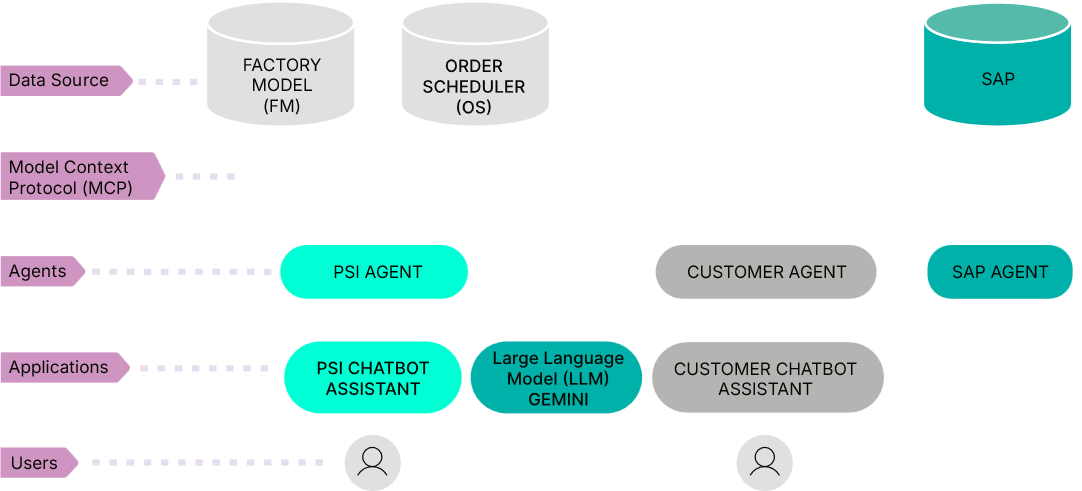
The entire diagnostic process is built upon the PSImetals Service Platform, which hosts the Factory Model, connects all applications, and provides fundamental core functions like User Authorization. The different “team members” from the analogy are all sharing their findings inside this Factory Model.
To accurately answer the delay query, we integrate data from all levels seamlessly:
- Order status and planning information
- Production progress on the shop floor
- Machine and sensor status
- Material availability and supply chain constraints
- Additional unstructured information such as emails and documentation
This integration ensures that the system can plan and perform an individualistic data lookup across the entire digital ecosystem.
While this holistic concept is already known and in use, a new element has been added: the possibility to open up the Factory Model to the world of Generative AI and establish the connection for the previously mentioned AI-based Chatbot.
An example of diagnostic flow: The recursive investigation
The process begins when the operator initiates the conversation with the following prompt to the PSImetals embedded Chatbot:
"Why is order #12345 late?".
- Understanding the question: The system interprets the natural-language query, identifies the order, and recognizes that the intent is to understand the reason for the delay.
- Planning the investigation: Just like a Lead Investigator, the system makes a plan. It determines what data is necessary and what analysis is required. This could involve brainstorming possible causes and looking up general information needed, including similar cases and their solutions in the past.
Phase 2: The investigation loop (recursive data lookup & analysis)
This is not a linear straight line, but a recursive loop where the "detectives" correlate clues until the case is solved. To speed this up, each detective tries to confirm a single possible cause from the brainstorming.
- Integrated data lookup: The system performs the needed lookups across all connected applications and data sources.
- Analysis & correlation: The Generative AI analyzes the raw data to identify correlations—for example, matching a delay in production progress with a machine sensor reaching a breakdown threshold.
- The recursive check: The system checks the information for completeness. It suggests a prioritized list of possible reasons. The user decides which reason to investigate in more detail (“divide & conquer”).
If the answer is satisfactory, the system proceeds to formulate the response. If there is a gap and the data is inconclusive (e.g., "Machine stopped, but why?"), the system triggers a new recursive data retrieval step. It digs deeper—perhaps checking maintenance logs or material availability—until the root cause is isolated.
If it becomes clear that an underlying hypothesis was wrong, feedback is given to the “team” as a whole, and a different path is pursued.
Phase 3: The report (response)
Once the "detectives" are satisfied that they have found the root cause, the PSImetals embedded Chatbot formulates a comprehensive answer in natural language:
"Order #12345 is delayed by 6 hours due to a breakdown of machine A at 10 AM today. Maintenance is in progress; estimated completion is 4 PM."
The operator's next move: From insight to action
Despite having a strong team of investigators at hand, the ultimate decision-making power remains with the expert operator. “Just one more thing…”. The PSImetals embedded Chatbot is not only providing valuable information in the first place; it can also be used to further validate the findings before taking action.
- Validation: The operator uses the PSImetals embedded Chatbot to verify whether the issue was purely operational or whether the root cause originated earlier, for example through cascading effects in constrained quotas or scheduling decisions.
- Reactive scheduling: Armed with the precise cause, the operator uses reactive scheduling functions—such as moving or reassigning heats, or adjusting fixed zones—to route orders around the bottleneck.
- Future prescription: To prevent recurrence, the operator can update rules or test changes using scenario workflows in PSImetals scheduling applications.
By combining flexible, recursive AI architecture with human expertise, PSI ensures that massive industrial data is instantly translated into operational intelligence.
Closing the reality gap – Case closed
At PSI, we are convinced that the question “Why is this order late?” should no longer trigger days of complicated guesswork just to be able to provide an answer. In short, our goal is to shift this question from being a costly investigative exercise into a standard, reliable capability—conquering production complexity by converting industrial data into actionable intelligence.
PSI’s Industrial AI features close this reality gap. By unifying order, production, machine, supply chain, and unstructured data within the PSImetals Service Platform, and by applying recursive, AI-driven diagnostics, PSI transforms raw industrial data into clear, contextual, and trustworthy explanations in minutes rather than days. The PSImetals embedded Chatbot does not just retrieve data; it correlates, reasons, and explains, delivering a natural-language answer that operators can understand and act upon.
“Info” section – extracted technical details
INFO: What is the PSImetals Factory Model?
The PSImetals Factory Model is the central data model of the PSImetals Service Platform. It acts as a single, consistent “source of truth” for all relevant production information across the steel plant.
Instead of scattering information across separate systems, the Factory Model consolidates:
- Order and product data
- Production genealogy and process history
- Machine and sensor states
- Quality and inspection results
- Scheduling and execution information
Because the Factory Model is shared by all connected PSImetals applications, it becomes the ideal foundation for AI-based analysis and natural-language interaction. When the PSImetals embedded Chatbot answers, “Why is this order late?”, it is effectively “reading” the story of the order from the Factory Model.
What is PSImetals MCP (Model Context Protocol Server)?
PSImetals MCP is a dedicated server that connects the PSImetals world with modern Generative AI technology.
Its role is to:
- Open controlled, read/write access from the AI side into the PSImetals Factory Model.
- Provide the language model with the right context (structure, relations, constraints) instead of raw, unstructured data dumps.
- Ensure that AI-powered answers remain consistent with the authoritative production data managed by PSImetals.
In practical terms, PSImetals MCP is the “translator” between industrial production data and the Large Language Model (LLM). It ensures that the AI never “hallucinates” plant facts but works strictly on validated information from the Factory Model.
INFO: What is PSIqualicision A2 (Ask and Answer)?
PSIqualicision A2 (Ask and Answer) is PSI’s technology for conversational document and data analysis based on modern language models.
Key characteristics:
- It uses Retrieval-Augmented Generation (RAG): the model does not answer from memory alone, but always retrieves relevant context from trusted sources first.
- It can process and generate technical texts in natural language, tailored to the role and question of the user.
- Integrated into PSImetals, it turns complex, multi-system queries into one consistent and understandable answer.
Within the “Why is this order late?” use case, A2 drives the iterative conversation: it interprets the operator’s question, retrieves and correlates the right information via PSImetals MCP from the Factory Model, and formulates a clear explanation.
INFO: System levels – ERP (L4), MES (L3), IoT (L2), and SCP
In the detective analogy, each “role” corresponds to an established system level in manufacturing IT:
- L4 – ERP (Enterprise Resource Planning): Manages commercial orders, contracts, and overall planning.
- L3 – MES (Manufacturing Execution System): Orchestrates production execution on the shop floor, tracking progress and status.
- L2 – IoT / Automation: Collects high-frequency data from machines, sensors, and control systems.
- Supply Chain Planning (SCP): Plans and monitors material flows, constraints, and availability across the value chain.
The PSImetals Service Platform and Factory Model bring these perspectives together. The embedded Chatbot, supported by MCP and A2, can then “interview” all levels at once, without the operator having to log into each system separately.
INFO: Recursive investigation – how the loop works technically
The recursive investigation described in the main text is implemented as an iterative loop between:
- The planning component, which generates hypotheses (possible causes, needed data).
- The data access layer (via PSImetals MCP), which executes targeted queries against the Factory Model and connected systems.
- The AI analysis, which correlates and evaluates findings, ranks possible reasons, and checks for missing information.
- The user guidance, where the operator selects which path to follow, refines questions, or requests more detail.
The loop repeats until the system converges on a consistent, well-supported explanation. This approach allows the solution to handle complex, multi-causal scenarios instead of just pointing to a single alarm or delay flag.