
What at first glance sounds like traditional detailed planning has a major impact on the entire production process in many plants. OEMs and suppliers, in particular, operate with tightly synchronized production lines, clear processes, and a wide variety of product variants. Hardly any two orders are alike. Nevertheless, different configurations and short-notice call-offs must fit into a stable production rhythm.
This is exactly where sequencing comes in. The concept describes the targeted sequencing of orders. The goal is to arrange approved orders so that they align with available capacity, line rules, and current specifications.
Why the order makes such a big difference
In mass production, standardized processes are increasingly encountering a growing number of variants. This is particularly evident in the automotive industry. While vehicles may run on the same production line, their specific equipment and variants place different demands on individual stations. The situation becomes critical not only when several complex orders follow one another in quick succession. Recurring workloads at the same station can also disrupt the production rhythm, for example when several vehicles in succession require additional work steps in the paint shop, in inspection-intensive sections, or at assembly stations involving high manual effort. Sequencing helps distribute such workloads strategically across the order sequence.
Suppliers also feel this dynamic. They often have to process call-offs on short notice while simultaneously meeting just-in-time or just-in-sequence requirements. If quantities, priorities, or delivery sequences change, a previously balanced plan can quickly become unbalanced. This increases setup costs and coordination needs, while shifts in the sequence directly impact material provision and material flow.

What a good sequence must do
Sequencing makes these interdependencies manageable. A sound sequence brings multiple objectives together. It ensures deadlines are met, evens out capacity utilization along the production line, and minimizes inventory and setup times. At the same time, it prevents labor-intensive jobs from being grouped together in an unfavorable way. In this way, it reduces the burden on equipment, employees, and planning teams.
However, it is often not possible to meet all previously defined objectives at the same time. Prioritizing one order may improve on-time delivery, but it increases setup costs. Those who significantly smooth out workload may be less flexible in responding to new priorities in the short term. Sequencing therefore always involves identifying conflicting objectives and making conscious decisions.
At its core, it is not about the theoretically perfect sequence, but about a robust sequence that works under real-world conditions. To achieve this, planning requires an integrated view of orders, variant characteristics, constraints, capacities, and feedback from production.
How PSIpenta/MES supports sequencing
PSIpenta/MES Sequencing implements this sequence planning using rules-based logic. The starting point is a consolidated order pool. This pool consolidates released orders, call-offs, priorities, and relevant characteristics. From this pool, a balanced order mix is first generated. It takes restrictions into account and distributes the workload as evenly as possible.
Only then does the system plan the specific sequence for individual lines or segments. This multi-step approach helps avoid prematurely prioritizing individual orders. The planning first evaluates the entire mix and derives a sequence that balances loads, rules, and priorities in a stable manner.
Sequencing also does not end with the initial planning. Production feedback, new call-offs, or changes in capacity can shift the initial situation at any time. PSIpenta/MES Sequencing continuously incorporates such feedback and helps adapt the sequence to new priorities, available capacities, and existing constraints.
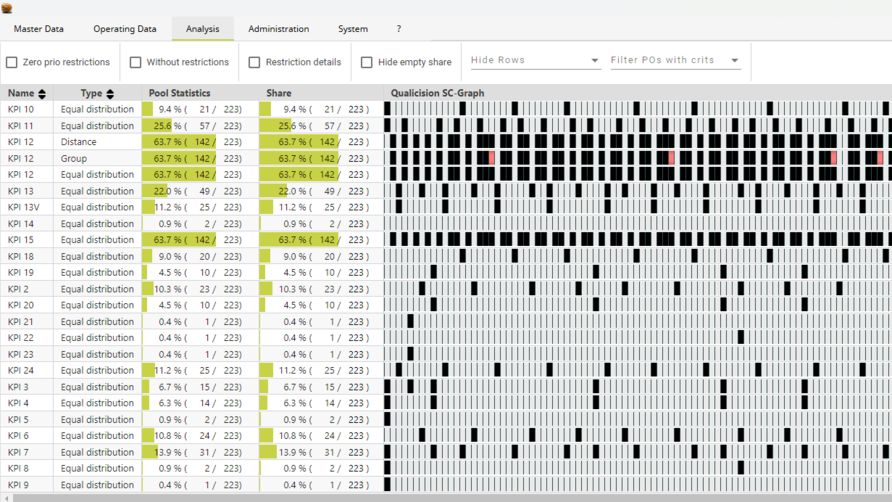
Sequencing as a data-driven basis for decision-making
Process knowledge, planning expertise, and experience remain indispensable in production control. However, with a high variety of variants, numerous rules, and short-notice changes, this foundation alone is not sufficient to evaluate all interactions quickly and reliably. Planners must identify where peak loads are likely to occur, which sequences of variants are critical, and how different sequences affect deadlines, capacity utilization, and regulatory compliance.
Optimization methods and AI can support this decision-making process. They check for constraints, compare alternatives, and highlight conflicting objectives. The final decision remains with the planners, but they are provided with a more robust foundation. This elevates sequencing beyond mere operational fine-tuning. A systematically designed sequence stabilizes processes, supports material provision and bottleneck management, and enhances responsiveness to last-minute changes.
HOW SEQUENCING IMPROVES PRODUCTION
- Stabilize order sequences
- Distribute workloads more evenly
- Better account for bottlenecks
- Make setup efforts more predictable
- Ensure material flows
- Manage call-off changes more effectively
- Identify conflicting objectives
- Make data-driven planning decisions