ERP and MES systems for discrete manufacturing must support complex industrial processes and requirements while also integrating data and applications. Companies therefore need IT applications with technological and functional depth that their employees can use easily and reliably.
This tension is also highlighted in the latest Trovarit study, ERP in Practice 2026/2027. For this edition, 1,538 ERP installations in Germany, Austria, and Switzerland were evaluated in terms of user satisfaction, benefits, and future prospects. Among other things, the study reveals that as software landscapes become increasingly decentralized, integration, data quality, architecture, and modernizability are gaining in importance. At the same time, 60.8 percent of respondents cited simplifying and accelerating processes as the most important perceived benefit of ERP.
Many companies are thus faced with a seemingly contradictory challenge: they must manage growing functional and technological requirements without passing on the associated complexity to their users. This is precisely where Simplification comes in.
What does "simplification" mean in ERP and MES?
For a long time, simplification in enterprise software was associated almost exclusively with usability and intuitive user interfaces. Today, the approach extends much further and also addresses workflows, decision support, and technical architecture.
In discrete manufacturing in particular, different production methods, resources, priorities, and customer requirements place high demands on processes and supporting systems. Simplification, therefore, must not mean having to sacrifice functionality. Rather, simplification aims to structure the necessary business and technical depth in such a way that companies can more easily use, customize, and further develop ERP and MES solutions.
How does PSI-Click-Design reduce complexity for users?
The user interface will continue to be a key driver of simplification. Role- and context-based interfaces limit screens to the information and functions users need for their specific tasks, while hiding additional details. This speeds up and simplifies operation and prevents erroneous entries. As a result, users can complete their tasks more efficiently and securely. In PSIpenta/ERP, the Click Design, among other features, supports this approach by allowing interfaces and views to be flexibly adapted to different usage scenarios—without requiring any IT or programming knowledge.
How does PSIpenta/QA2 simplify access to information?
As functional depth increases, so does the amount of information available in ERP and MES solutions, as well as in accompanying documentation. This can make it all the more challenging for users to quickly and specifically access the knowledge they need in a given situation. In line with this, the Trovarit study identifies not only process simplification but also rapid access to information and fact-based, useful information as key perceived benefits of ERP.
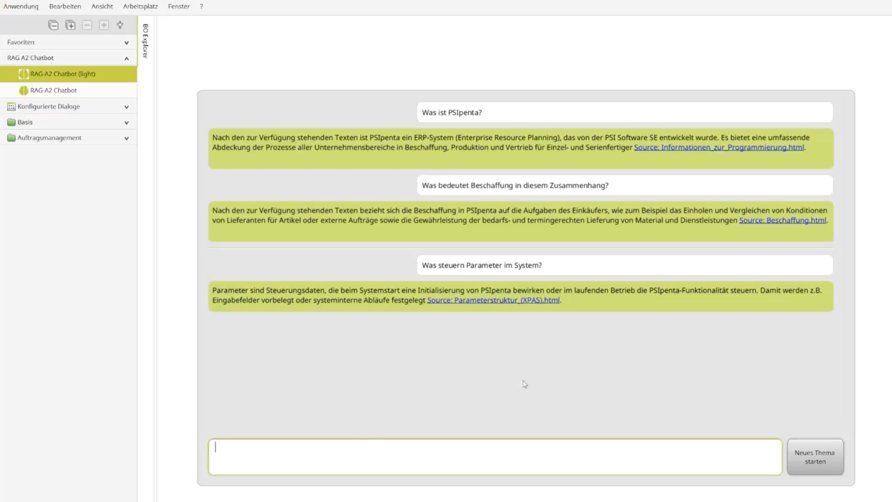
With its Simplification approach, PSI therefore also focuses on access to information. AI enables a new form of interaction here by making existing knowledge accessible through dialogue. An information retrieval function based on Retrieval Augmented Generation (RAG) is used. Instead of manually searching for information in process documentation, DokuWikis, or manuals, users ask specific questions and receive structured and reliable answers. This makes existing knowledge more easily accessible and reduces search time.
How does AI help with complex decisions?
Decision-making in planning and control—which requires simultaneously taking into account numerous parameters, interdependencies, and conflicting objectives—has also become a challenging task for many companies. AI and optimization techniques simplify decision-making by analyzing complex interrelationships, comparing scenarios, and identifying possible courses of action. In production planning, for example, machine-learning algorithms use historical planning patterns, suggest alternative sequences, and identify bottlenecks early on. In this way, the system consolidates a multitude of influencing factors into a reliable foundation that helps users make the right decisions without taking those decisions away from them.
How does PSIpenta/Workflow Developer simplify the customization of processes and rules?
Simplification applies not only to user interaction but also to the representation of business logic within the system. It is precisely this logic that companies and their business departments must regularly adapt in response to changing requirements. If this requires custom programming, companies must rely on their own—often limited—resources in the IT department or on external support. Both options involve significant technical effort and frequently result in delays.
Simplification therefore separates business logic from the program code. With the PSIpenta/ERP Workflow Developer, processes can be modeled graphically and in a business-oriented manner based on BPMN 2.0. This allows changes to be implemented flexibly and quickly without having to modify the program code.
Learn more about the PSIpenta/ERP Workflow Developer (GER only)

How will the system architecture help simplify things in the future?
As system landscapes become increasingly interconnected, the technical complexity behind the scenes is also growing. Data must flow between applications, functions must work together, and new components must be integrable with as few far-reaching dependencies as possible.
From a simplification perspective, architecture is therefore also gaining in importance. For PSI, this is a key area of development. The goal is to consistently expand technological depth and integration capabilities—in part through modularization—while simultaneously simplifying the use and further development of its systems for businesses.
Simplification as a Benchmark for Further Development
Companies need ERP and MES solutions that are powerful and interconnected, yet are as easy as possible to use and upgrade. The Trovarit study confirms this dual requirement. Integration, architecture, and modernizability are gaining in importance, while simplifying and accelerating processes remains the most important perceived benefit of ERP. Simplification is therefore also a central design principle for the further development of PSIpenta/ERP and MES.