Hannover Messe 2026 made it clear: Industrial AI has arrived in the industry. What was still considered an abstract promise of the future just a few years ago is now evident in concrete application areas for production, logistics, energy, and far beyond. The focus is no longer on whether Artificial Intelligence is used in industry. Rather, the key issue is how it measurably optimizes business processes, supports decision-making, and makes existing system landscapes smarter. Once again, PSI brought this transformation into sharp focus at the Hannover Messe.
PSI demonstrated its decades of experience in Industrial AI as well as in AI-supported decision-making and optimization methods: relevant PSI products have been in use for around 30 years. What is new, however, is the quality of the interaction: adaptive algorithms can now be combined with Generative AI. This makes them significantly more accessible to users. Industrial AI is evolving into an even more powerful component that operates in a more understandable way and is closer to operational processes. At the event, we captured the most important Industrial AI trends.
Overview of the Industrial AI trends
- Generative AI makes industrial algorithms accessible
- Video: Recap Hannover Messe 2026
- MES as intelligent control platform
- Mobile ERP and MES solutions bring AI closer to the shop floor
- Logistics optimization replaces rigid strategies
- Production data and system knowledge converge
- From reactive planning to data-driven processes
- Energy utilities benefit from AI
- Conclusion: Industrial AI requires scalable architectures
Generative AI makes industrial algorithms accessible
A key trend at Hannover Messe 2026 is the new role of Generative AI as an interface between people, systems, and algorithms. In many industrial companies, planning and optimization systems are highly powerful but not always intuitively accessible. Users must understand complex parameters, know system logic, and consolidate various information sources.
At the trade fair, PSI showcased a new development that addresses this very issue: interaction with algorithms is elevated to a voice-controlled level. The combination of Adaptive AI decision-making and optimization algorithms with Generative AI in RAG (Retrieval Augmented Generation) systems makes this possible. As a result, Adaptive AI algorithms can not only continuously calculate their results but also explain them in a way that is understandable to people with process expertise. The added value is that industrial systems no longer just output results but engage in a dialogue with users.
Voice-controlled interaction
Planners can ask questions, examine relationships, and better understand decisions. Generative AI is thus evolving into a translation service between optimization logic and day-to-day work, for example in an ERP system. PSI demonstrated an assistant enhanced by Generative AI that not only provides relevant information in response to questions but also offers context-specific recommendations for action. The major advantage: users can leverage existing system knowledge directly within the process.
One more finding in this context: Enterprise Resource Planning (ERP) is increasingly moving away from being a mere database toward becoming an active control mechanism for production processes. At the Hannover Messe, PSI introduced new ERP functions that support precisely this development. The focus is on the control and optimization of production processes, supplemented by AI-supported features such as document capture. This helps organizations capture and structure information more quickly and transfer it into digital processes. Particularly in industrial environments where documents, orders, technical information, and process data interact, this feature reduces media breaks and accelerates workflows.
Video: Recap Hannover Messe 2026
MES as intelligent control platform
Flexibility remains one of the most important competitive factors in the manufacturing industry, and not just because of geopolitical challenges. The industry is struggling with many challenges: product variety, fluctuating material availability, short-notice changes, and increasing demands on deadlines and quality are putting pressure on production planning. The need for solutions that address this challenge with effective, innovative ideas was also evident at the Hannover Messe. To this end, PSI showcased the cloud- and workflow-based Manufacturing Execution System (MES) that, with AI-based functions in the Sequencing module, enables intelligent and balanced detailed planning for line production. The focus here is not on viewing planning decisions in isolation, but on harmonizing different target metrics.
In line production, it is crucial to plan sequences, resources, material flows, and capacities as balanced as possible. AI-based sequencing functions can help evaluate complex dependencies more quickly and provide better suggestions for operational detailed planning. The trend shows that MES systems are evolving from pure execution and feedback systems into intelligent control platforms. They combine operational proximity to production with algorithmic optimization, thereby creating an important foundation for adaptive manufacturing processes.
Mobile ERP and MES solutions bring AI closer to the shop floor
One thing is certain: Industrial AI only unfolds its value when it is available where decisions are made. Therefore, mobile, workflow-based applications are gaining massive importance, as industrial processes are rarely static. Roles, workflows, information needs, and priorities vary depending on the department, location, or task. Rigid interfaces and predefined process paths are often only partially suitable for this. Workflow-based mobile solutions bring users closer to the actual work situation. Users can capture information on the go, map processes more flexibly, and tailor interfaces more closely to their requirements. Combined with AI-based functions, a new form of industrial assistance emerges. Thus, Industrial AI is not just a topic for planning and management, but also for the shop floor. PSI offers mobile ERP and MES solutions that enable dynamic process modeling and the customization of user interfaces.
Logistics optimization replaces rigid strategies
In intralogistics, too, the shift from fixed rule sets to adaptive optimization approaches is evident. Today, warehouse processes must become faster, more efficient, and more robust. At the same time, demands on delivery capability, transparency, and resource utilization are increasing.
In Hanover, PSI presented, among other things, further developments of its Warehouse Management System. This includes the Batch AI module integrated into the standard system: It optimizes single-stage and two-stage picking strategies using rule-based and AI-supported batch building.
The benefits are clear: orders can be intelligently bundled. Instead of operating solely according to rigid rules, the system can take various factors into account and make batch decisions more dynamically. As a result, commissioning distances are reduced, picking processes are accelerated, and warehouse efficiency increases.
Especially in times of volatile demand and high service expectations, this flexibility becomes a decisive advantage. Warehouse management thus becomes not just inventory and process management, but an active optimization agent in the supply chain.
Production data and system knowledge converge
The fact that production data and system knowledge belong together has changed the world—gaining new momentum—at least since the advent of AI. A particularly exciting use case is evident in the metals industry. PSI presented a cloud-enabled and service-oriented production management solution focused on generative AI. A central element is the Model Context Protocol (MCP) interface for the PSI Factory Model.
The associated chatbot “Factory Model & Documentation” combines direct database access to production data with in-depth knowledge from system documentation for the first time. It creates an intelligent bridge between operational data and technical system understanding. For users, this means that production information can not only be retrieved but also interpreted within the context of the system logic. Questions regarding processes, data structures, or production statuses can be answered with greater alignment to the real-world situation. This approach opens new possibilities, particularly for maintenance, process optimization, technical analysis, and engineering.
The trend behind this extends far beyond the metal industry. Industrial AI is particularly effective where data does not remain isolated but is linked with models, documentation, and process knowledge.
From reactive planning to data-driven processes
Industrial AI is transforming not only individual functions but also the fundamental understanding of industrial planning. Some companies still operate in a highly reactive manner: they respond to bottlenecks, deviations from plans, material issues, or capacity conflicts as soon as they become apparent. PSI addresses this trend and demonstrates, using practical examples from the mechanical and plant engineering sectors, how the transition from reactive planning to data-driven processes can be successfully achieved. The focus is always on the question of how companies can optimize their production capacity utilization through AI-based functions.
This is particularly relevant for mechanical and plant engineering, where complex order structures, a high variety of variants, and limited resources converge. Data-driven planning can help here to identify bottlenecks earlier, evaluate alternatives more effectively, and manage capacity utilization in a more targeted manner.
The combination of fact-based AI decision-making and optimization software with Gen-AI-based RAG applications represents a significant step forward. It shifts interaction from a numerical to a linguistic level and significantly improves the explainability of results as well as the controllability of AI optimizations.
Energy utilities benefit from AI
The control and management of modern utility grids is becoming increasingly complex: Volatile conditions, strict regulation, and the pressure for maximum efficiency and safety require, more than ever, a seamless, digitized, integrated, and intelligent solution. Against this backdrop, PSI presented its end-to-end, digital, integrated solution for grid management, operations, and maintenance. Combined with its mobile solution, PSI bridges the gap between the control center and the field. Not least, with its cross-sector control system, PSI is also developing an innovative and integrated AI-powered solution to ensure a sustainable energy supply.
For algorithmic intraday trading, PSI showcased the Qualicision Smart Day Trader module: It impressed with its intuitive goal function configuration via graphical KPI controls as well as explainable AI. Decisions and their underlying decision-making process can be visualized in real time, ensuring that the trading process remains transparent. PSI also has an answer to the growing threat of cyberattacks on grid operators and demonstrated its AI-based solution for close-meshed, continuous real-time monitoring of grid assets.
Conclusion: Industrial AI requires scalable architectures
The examples from the Hannover Messe make it clear: AI does not deliver its industrial benefits in isolation. It requires data, process integration, and scalable architectures. Cloud-enabled solutions, service-oriented applications, mobile workflows, and intelligent interfaces therefore form an important foundation.
In particular, the combination of cloud- and workflow-based MES, mobile ERP and MES applications, AI-supported document capture, and generative AI shows the direction in which industrial software is evolving: away from closed, standalone systems and toward more interconnected platforms. The combination of fact-based AI decision-making and optimization software with Gen-AI-based RAG applications represents a significant step forward. It shifts interaction from a numerical to a linguistic level and significantly improves the explainability of results as well as the controllability of AI optimizations.
Overall, the focus is shifting from abstract AI promises to usable functions: in ERP, MES, WMS, production management, and energy supply, as well as in other industrial applications. Using Large Language Models (LLMs) and specialized RAG-based document embeddings, the applications take on a more chat-like character while still being able to optimize numerically with high efficiency.
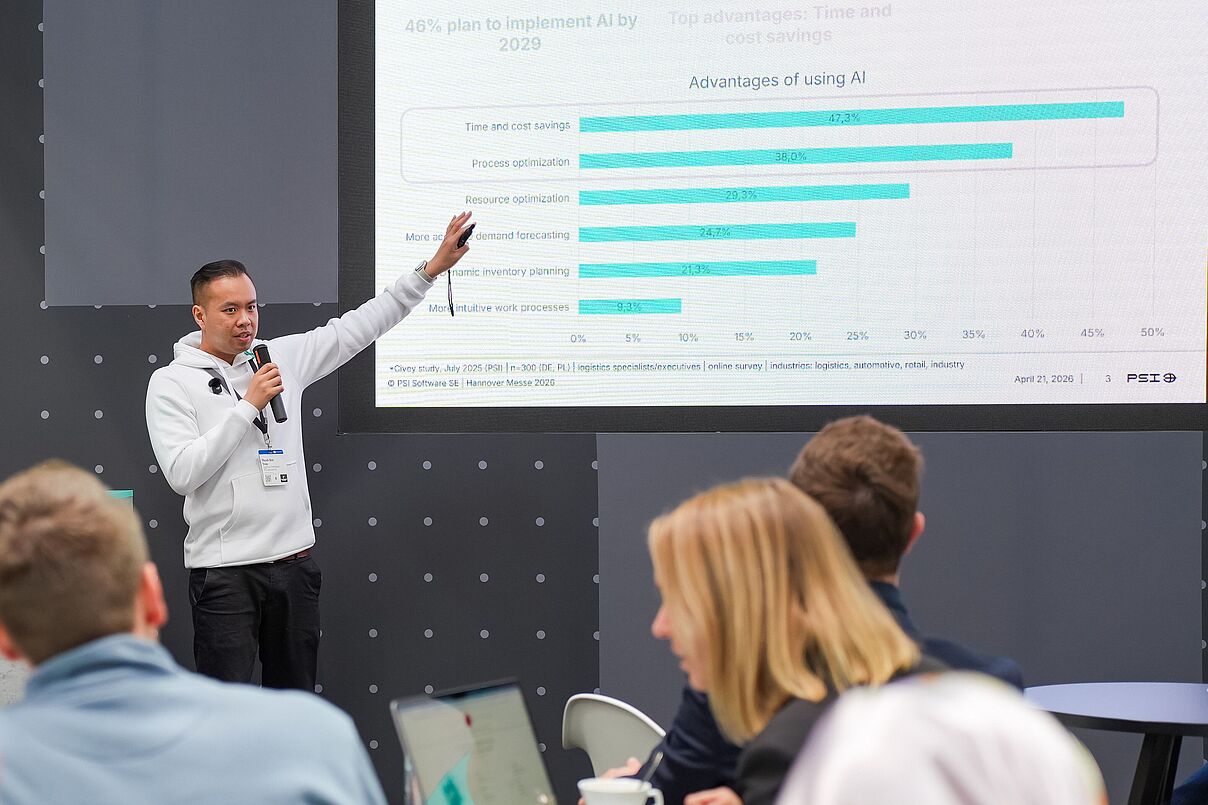
At Hannover Messe, PSI positioned itself as a long-standing and innovative expert in Industrial AI with a comprehensive portfolio of AI-based solutions. This was reinforced by numerous presentations on AI-focused topics at the booth and in forums, a showcase, and the “AI in Manufacturing” Guided Technology Tour organized by Hannover Messe. In addition, PSI won the Factory Innovation Award 2026 in the category “Artificial Intelligence in the Factory”.